簡(jiǎn)介:深水
勘探開發(fā)早已經(jīng)成為全球
油氣勘探行業(yè)的焦點(diǎn)。隨著陸上以及淺海油氣資源的越來(lái)越少,許多公司不得不考慮想更深水域進(jìn)軍。這對(duì)于使用于深水的油管提出了更高要求,深水管線要求管徑更大,壁厚更厚,并能在海底彎曲鋪設(shè)。U
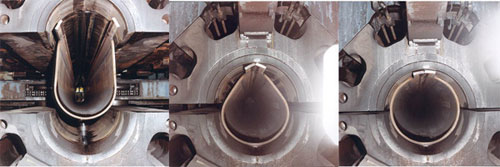
OE技術(shù)是先把鋼板折為U型,再折為O型,然后再四周擴(kuò)展該成形管的一種新技術(shù)。
Conventional pipeline design is generally dominated by the need to withstand internal pressure in the line. The higher the pressure that products can be passed down the line, the higher the flow rate and greater revenue potential for the operator. However when discussing critical factors for deepwater pipelines, the challenge becomes dominated by resisting the external hydrostatic pressure, particularly during the installation phase.
Local “infield” lines, such as subsea umbilicals, risers, and flowlines tend to present a modest challenge as they are small in diameter and as such are inherently resistant to hydrostatic collapse. These lines are generally produced as seamless pipe, which in smaller sizes is readily available and generally a suitable economic solution.
Deepwater trunk lines and long distance tiebacks, however, present the greatest challenge for pipeline design. These lines tend to be larger in diameter for increased subsea production, and a thicker pipe wall is required to ensure the pipes can withstand the hydrostatic pressure and bending as the pipe is laid to the seabed.
Typically these lines are 16 in. to 20 in. in diameter, which presents a further complication as the pipe sizes lie at the top end of economical production for seamless (Pilger) pipes. The Pilger process can produce the thick-walled pipe required for these developments, but the manufacturing process is slow, and the cost of material is high.
The most economical method of manufacture for these lines is the UOE process, which is carried out by pressing a steel plate into a U and then O shape, then expanding the formed pipe circumferentially. However, the increasing demands of the industry drive the design toward its practical limits in terms of timely, safe, and successful installation and operation, as well as cost efficiency.
Pipe Shape
Few pipe producers are able to manufacture UOE pipes at 16 in. to 20 in. outside diameter, but this manufacturing route is quicker to market and more cost-effective than seamless alternatives.
A program of research and development at Corus Tubes has led to a greater understanding of the mechanisms during pipe forming, and it is now possible to reverse this effect to one yielding higher compressive strengths than would normally be expected, providing the potential for reducing pipe wall thickness for future deepwater applications.
Pipe manufactured by the UOE process undergoes various strain cycles, both tensile and compressive. The combination of these cycles affects the overall behavior of the material in compression. This is indicated in the Det Norske Veritas (
DNV) equation by the presence of the Fabrication Factor. For standard UOE processes, the term represents a de-rating of 15% in the compressive strength as a result of the material response to the strain cycles during forming, known as the Bauschinger Effect.
The particular qualities of Corus Tubes manufacturing process optimize the design of the material, while minimizing the specified nominal wall thickness of deepwater pipelines. This delivers a reduction in material and welding costs as well as in installation time and pipe weight, important for logistics and submerged pipe weight considerations.
The finished pipe shape is determined during the manufacturing process and can be optimized by balancing the manufacturing parameters, pipe compression, and expansion.
The strength of Corus Tubes crimp, U-press, and O-press combinations ensures the pipe size is controlled to the highest degree. The resultant enhanced pipe “roundness,” wall thickness, and diameter tolerance can assure designers of the manufacturing quality of the pipe, removing uncertainty in the design and production stages and allowing the optimization of the pipe wall thickness.
Proven ability
The company has played a key role in a number of groundbreaking projects, most recently supplying line pipe to the Perdido Norte project in the Gulf of Mexico (GoM), one of the world’s deepest pipelines. Williams commissioned the company’s expertise in the production of small diameter UOE pipe. Approximately 194 miles (312 km) of line pipe weighing approximately 77,000 metric tons was delivered for use in ultra-deep water depths ranging from 3,500 to 8,300 ft (1,067 to 2,530 m), with a rugged seabed terrain.
One section of the pipeline transfers hydrocarbons from the FPS host in Alaminos Canyon 857 and terminates in East Breaks Block 994, a distance of 78 miles (125.5 km).
The gas pipeline terminates at Williams’ Seahawk pipeline in East Breaks Block 599, 106 miles (171 km) away. The 18-in. diameter pipe was manufactured in wall thicknesses ranging from 19.1 mm to 27 mm thick, the thickest wall/smallest diameter produced by any UOE manufacturer.
In 2001, Corus Tubes supplied 58 miles (94 km) of three-layer polypropylene coated, high grade, sour service line pipe and bends weighing approximately 45,000 metric tons for the technically challenging Bluestream project, which supplies gas from Russia to Turkey under the Black Sea.
The company was one of three suppliers for this major project. The excellent collapse resistant properties of the Corus Tubes pipe led to its being selected to be laid at the deepest section of the pipeline at 7,054 ft (2,150 m).
The company had been previously selected in 2000 by ExxonMobil to supply 40 miles (64 km) of line pipe for the Exxon Hoover/Diana project, which reached depths of 4,800 ft (1,450 m). This was also the first time that small-diameter pipe from Corus Tubes’ UOE mill in Hartlepool was supplied to the deepwater GoM market.
The bottom line
Pipelines in deepwater require the tightest dimensional tolerances to maximize resistance to external hydrostatic collapse and maximize girth weld fatigue resistance.
Furthermore, pipelines from 16 in. to 28 in. are seen as the future for deepwater export pipeline systems. Significant manufacturing cost and technical savings can be achieved by using UOE as an alternative to the seamless pipe making Pilger process.
Corus Tubes continues to invest considerable time and resources into understanding pipeline performance in deep water. This research, coupled with extensive experience in the supply of UOE line pipe in diameters of 16 in. and 18 in., will enable the realization of projects that would be uneconomical and impossible to lay using current technology.
您的分享是我們前進(jìn)最大的動(dòng)力,謝謝!
 發(fā)布信息


